James Bond isn’t the first thing that comes to mind when you think of gardening, yet the creator of this garden is said to have inspired Ian Fleming’s famous character. Sir Peter Smithers, botanist, diplomat (and perhaps spy), and later MP for Winchester from 1950 to 1964, lived in Colebrook House just beyond the wall opposite the garden. His wife’s golden typewriter even appeared in the film Goldfinger.
Smithers created this garden in 1958 as a welcoming viewing space for local people at the gateway between the city and the inner close of Winchester Cathedral. He bought a terrace of small cottages on Water Close that had been condemned by the City’s slum clearance programme and demolished them to create a new garden.
In 1969, Sir Peter Smithers sold Colebrook House and the Water Garden to Lady Barbara Ann Calcutt, who cared deeply for the garden. Following her death in 2015, her executor sold the Water Garden separately from Colebrook House. It was bought in 2018 by Alan Stone.
The sale sparked fears that the land would be developed. In 2020, Stone submitted a planning application for a two-storey dwelling on the site, along with two new openings in the garden wall. It quickly became one of the most controversial planning applications Winchester had ever seen, receiving more than 1,000 objections. The City Council refused the application, and although the Water Garden was safe from development, it had become neglected and overgrown.
At this point, Winchester resident John Airey stepped in.
John has a long-standing connection with the Water Garden, which he passed frequently as a child on visits to the cathedral with his father. In the photograph below, he is pictured in front of the garden aged just seven.
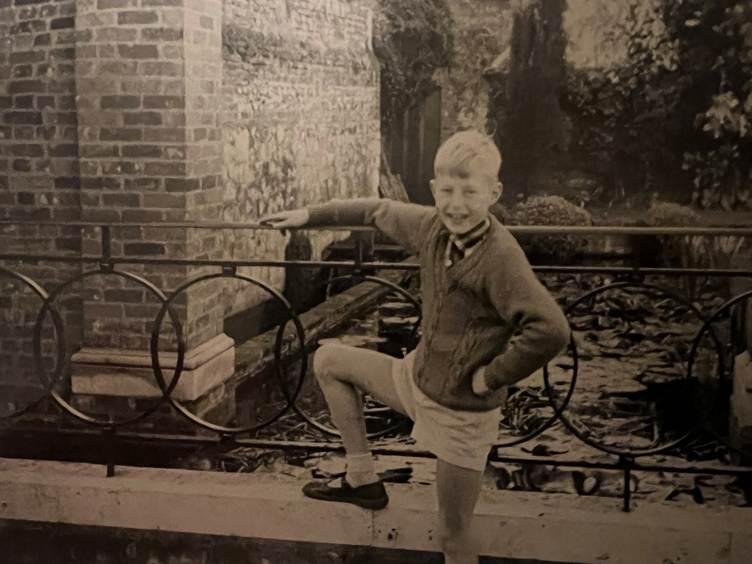
John, as a boy, is pictured in front of the Water Garden.© John Airey
When the planning application was refused, John devised a bold plan. He offered Alan Stone more than the original purchase price, and solicitors were instructed to proceed with the sale. John says his motive was “selfish”: he wanted to create a lasting legacy for himself and for Winchester.
His vision was to open the Water Garden to the public. He imagined a small memorial chapel in one corner, and another space dedicated to Jane Austen. He envisaged six stained-glass arched doors commemorating key figures associated with Winchester, including Sir Walter Raleigh, William Walker, and William of Wykeham. Local artist Kelvin Pearce illustrated what this might have looked like. John also wished to honour Peter Smithers and Ian Fleming, whose wartime intelligence work saved many lives, and to make the little-known connection between James Bond and Winchester more widely known. The close could also have featured plaques honouring members of the armed forces, providing a quiet place for reflection. His ambition was for the garden to hold the same cultural prestige as a museum.
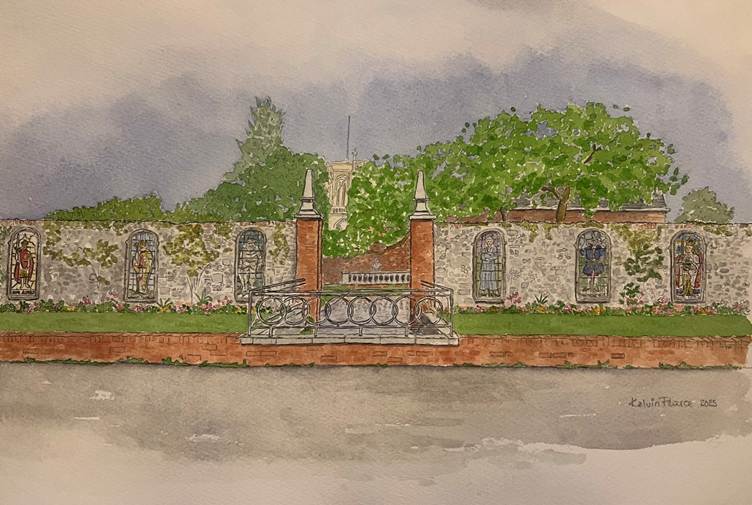
Kelvin Pearce’s illustration of the proposed Water Garden design. © John Airey
John imagined newly married couples using the garden for photographs, and for Winchester Guides and others to lead groups inside at organised times.
However, on the night before exchange and completion, the solicitors uncovered a strict covenant on the land. This restrictive covenant, created in 1968 and instigated by Sir Peter Smithers, presumably to protect the garden, states that only the owner can use the Water Garden. The public cannot be admitted; only the owner may benefit from the garden. While it may be possible to remove the covenant, the process would be lengthy, expensive, and uncertain. As a result, the sale could not go ahead.
Despite this setback, John was determined to improve the garden, which had deteriorated in recent years. Alan Stone kindly permitted him access to carry out the work.
John is aware that one of Sir Peter Smithers’s original intentions was for the cathedral to be reflected in the central pool. However, the magnolia tree planted by Smithers has grown so tall that the reflection is no longer possible. John hoped to remove the crest from the top of the tree but was told it would take the council at least six weeks even to review the request, so no trimming could take place.
Nonetheless, John has done a remarkable job restoring the garden, spending more than 200 hours working there over the summer of 2025 – work he says he thoroughly enjoyed. He removed 50 years of silt from the water and collected all the coins thrown in over the years, donating them to the Royal British Legion on Poppy Day. He removed the old lilies, whose root ball had become enormous, and replaced them with new plants. He has also introduced six koi carp to the pond and visits them in the evenings to give them a tasty supper.
 Winchester Walks
Leave a comment