Practical matters
This walk can take you inside Winchester Cathedral, but if you don’t have the time, or inclination to buy a ticket, please miss stop number 4. There is plenty to see outside for free.
If you do want to see inside the Cathedral, prices and opening times are here: https://www.winchester-cathedral.org.uk/welcome/plan-your-visit
- The walk also takes you past Winchester College – you might want to include a guided tour. If so, please check for times and prices: https://www.winchestercollege.org/visit-us
- We finish the walk at Wolvesey Castle, which has free entrance but slightly erratic opening hours, so please check before setting off: https://www.english-heritage.org.uk/visit/places/wolvesey-castle-old-bishops-palace/
On a fine day, Wolvesey Castle is a great place to have a picnic!- We start the walk opposite 35-39 High St, facing Boots the Chemist, but you could do it in reverse, in which case start at Wolvesey Castle (Old Bishop’s Palace), College St, Winchester SO23 9NB. The route, either way, is about half a mile long with eight stops.
Background
This walk follows in the footsteps of William of Wykeham, who was Bishop of Winchester between 1367 and 1404. In this period the Bishops of Winchester were among the wealthiest men in England and often held other high offices of state such as Lord Treasurer and Lord Chancellor. Winchester was one of the country’s largest and richest bishops’ domains, stretching from the south coast up to Southwark just south of London. What is interesting about William of Wykeham is that, unlike most other bishops at that time, he didn’t come from a noble family. He was born in 1324, the son of an ordinary man called John Longe who lived in the village of Wickham, about 15 miles from Winchester.
Despite his humble origins, Wykeham made his way to high office and fabulous wealth. It seems he did this not through any nefarious means, but by being super talented. So, his story is that of a poor boy made good.
Stop 1: Boots the Chemist
Our walk begins in Winchester High Street, standing opposite Boots the Chemist. If you look up you will see statues of four bishops of Winchester: Athelwold, Walkelin, Wykeham, and Fox.
They are here above this chemist because in the early twentieth century Boots built shops like this one in several cities, each in a different historical style and decorated with statues of local dignitaries. This shop was built in 1905, in the Tudor style. The statue of Wykeham makes him look rather severe. Indeed, there is evidence he could be severe – he berated the nuns in Romsey Abbey for keeping pet dogs, birds and rabbits, adding that these pets would put their souls in grave peril.
You’ll see that the statue is holding a model of a church. Although Wykeham became a bishop, he didn’t start his career as a priest. He seems to have been a talented administrator, with skills as an architect and builder. His early job was as secretary to the Constable of Winchester, where he learned about building, and he was soon appointed Surveyor of Windsor Castle, Leeds Castle, and many other royal properties.
The King, Edward III, recognised his talents and rewarded him by giving him income from various churches. In order to receive these preferments, as the incomes were called, Wykeham became ordained as a priest in 1363.
Stop 2: The Butter Cross Monument
We don’t have to go far to find our next statue of Wykeham: walking a few paces to our right we come to the Butter Cross Monument. There was probably a Holy Cross here in Wykeham’s time, but this one was built later, it is thought by his successor, Cardinal Beaufort, in the mid-1400s. It is called the Butter Cross because farmers probably set out their butter and other dairy produce for sale here on market days.
Looking up you will see four large statues facing outwards. They are William of Wykeham, Lawrence de Anne (who was a mayor of Winchester), King Alfred the Great, (the ninth-century warrior and scholar who had close ties with Winchester), and (facing the nearby building) St John the Evangelist or possibly St Amphibalus.
The famous architect Gilbert Scott restored the Butter Cross in 1865. It is thought that only the statue of St John/St Amphibalus is original and the other three, including our Wykeham, were created as part of the restoration work.
Wykeham was not just a good architect and surveyor, King Edward III promoted him to Lord Keeper of the Privy Seal, as his own Secretary, and finally Lord High Chancellor of England, the most important post a non-royal could hold. It was said:
“At this time reigned a priest called William of Wykeham. This William of Wykeham was so much in favour with the King of England, that everything was done by him, and nothing was done without him.”
Wykeham’s personal wealth grew with all the preferments, giving him an annual income of £800 per year. It is quite difficult to convert the value of money in that period into today’s terms, but a useful website (Measuring Worth.com) says that £800 is at a minimum the modern equivalent of around £613,000.
In 1367, when William was 42 years old, he was appointed Bishop of Winchester, becoming an even richer man.
From the Butter Cross Monument take the narrow street behind it, to The Square, and cross. When you reach the road, cross it and walk past the City Museum, go through the opening and take the tree-lined path towards the Cathedral in front of you.
Stop 3 (Winchester Cathedral – facing the west door)
The Cathedral was built on the orders of the first Norman king, William I, with construction starting in 1079. By the mid-1300s the original Norman architecture must have looked pretty old-fashioned. I like to think that Wykeham’s predecessor Bishop Edington visited nearby Salisbury Cathedral and got architectural envy. He set about a great and costly building project, transforming this west front and the nave into the latest style, what we now call Perpendicular Gothic. Although Bishop Edington started the work, it was William of Wykeham and his master mason William Wynford who completed most of it.
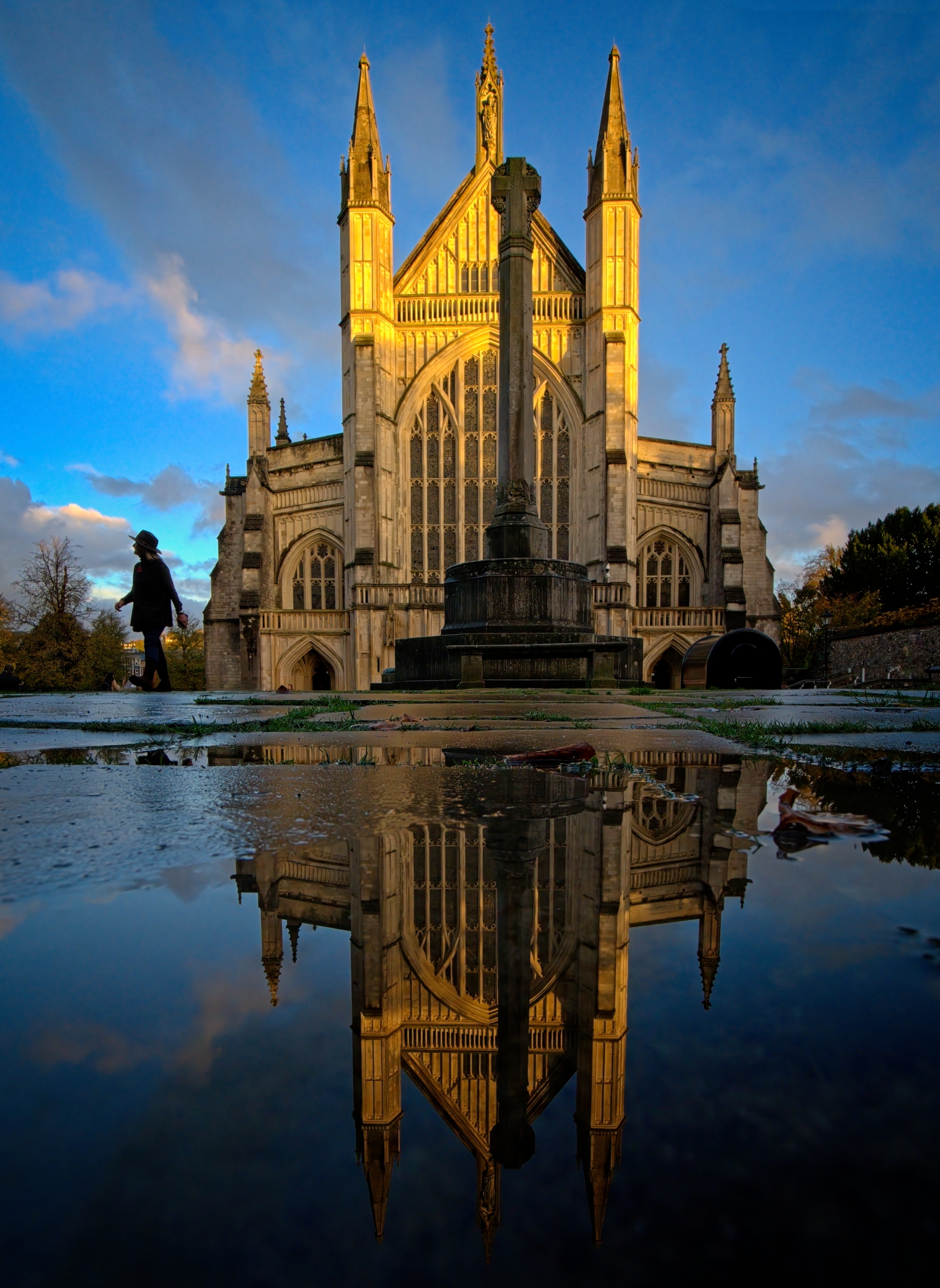
The original Norman architecture was replaced with what we see today. Above the balcony is the Great West Window, with its strong vertical lines. The window perhaps doesn’t strike us so much now, but in Wykeham’s day it would have been an amazing sight, because architects had only just discovered the technology to build such large windows without a supporting round arch.
Stop 4 Winchester Cathedral, interior
(If you don’t want to go into the Cathedral proceed to stop 5)
On entering the Cathedral, walk across from the entrance to the south aisle. There you will find the Chantry Chapel of William of Wykeham. He died on the 27th of September 1404, aged eighty. He is buried inside the alabaster tomb chest decorated with shields of arms, and on top of it is his effigy dressed in bishop’s robes.
Today, Winchester Cathedral is a Protestant church, but until the 1530s this and all other churches in England were Catholic. During this period quite ordinary people –not just the very wealthy – would give money to the monks of the Cathedral to say prayers for their souls after they died. They believed that, after death, the souls of moderately bad sinners went to a rather horrid place called Purgatory, but that these prayers could speed up the time they had to spend there before being admitted to Heaven. Rich people would leave enough money for the monks to chant prayers for them every day, in perpetuity – forever. However, there was a concern that over the generations, the monks would forget whom they were praying for, so the super-rich would build these chantry chapels, with their effigies and coats of arms, so there was no risk of the monks forgetting who they were.
Although Wykeham was ordained at a fairly late stage in his career, he seems to have been a religious man. It is said the chapel was constructed on the site of an altar dedicated to the Virgin Mary, where as a boy Wykeham had heard the mass chanted by one of the monks, Richard Pekis. The chantry chapel was completed in 1403, the year before Wykeham died.
At Wykeham’s feet are placed three figures of what appear to be praying Benedictine monks. However, I have been told that these are not monks, but the executors of his will, and that their robes were originally painted red, not black as they are now. There are also charming angels on either side of his head.
Wykeham did not leave money for his prayers directly, because he had already paid a great deal for the restyling of the Cathedral. Instead on the 16th of August 1404, he signed an agreement with the Prior of the monastery, for three monks to sing three daily masses in his chantry chapel in perpetuity, and for the choir boys to say their evening prayers there for his soul.
Leave the Cathedral by the south door, turn left, and take the passageway immediately on your left. This takes you to the Cathedral Close. Follow the pavement to your right and stop mid-way on the green area. This gives you a great view of the Cathedral architecture and Wykeham’s work.
Stop 5: Cathedral Close
From here you get to see how the architecture of the Cathedral was changed from the Norman to the Perpendicular style. Look at the south transept in front of you, where you will see three tiers of round-arched windows. Originally the entire Cathedral was built in this style. It’s called Romanesque because, in effect, the Norman builders were following the building style of the ancient Romans. In contrast, the nave shows what a transformation was made. Instead of the massive sturdy architecture of the Normans, Wykeham and his master mason created an elegance of vertical lines and large windows with long pointed arches.
Now continue along the pavement, following it along, passing The Pilgrims’ School. Go through the gate which takes you out of the Cathedral Close, take the first turn to the left, and go under the arch.
Stop 6: Wykeham Arms
Just ahead on Kingsgate Street is the Wykeham Arms. There has been a pub here since 1775. In the 1900s this was Winchester’s red-light district, and the pub was known as the Fleur de Lys. Now it is a charming place named after our favourite Bishop of Winchester.
You will see outside the pub the crest of William of Wykeham. The three Hampshire roses celebrate his birthplace; the two chevrons, representing gables, recognise his achievements as a builder; and the single mitre celebrates his position as Bishop of Winchester.
Retrace your steps to the corner of the street, turn right into College Street and walk about 130 metres, to Winchester College.
Stop 7: Winchester College
The tall gateway is known as the Outer Gate and is directly under an original statue of the Virgin and Child.
Wykeham founded Winchester College (or The College of the Blessed Mary of Winchester, to give its full name) in 1382 as a boarding school for 70 Scholars and 16 Quiristers, or choir boys. The College boasts the longest continuous history of any English school.
During Wykeham’s lifetime, the Black Death was a pandemic that ravaged Europe. Between 30 and 40% of the English population died and in some villages the death toll reached 80-90%. All occupations were affected, but the clergy were particularly hard hit: in Winchester 49% of the clergy and 44% of monks in the diocese died, making it the worst-affected diocese in the country.
Wykeham was keen to recruit new, educated priests to replace those who had died. He was also keen for poorer boys, such as he himself had once been, to have the opportunity to train for the church. In addition, he had huge wealth that he could put to philanthropic use. So, in 1379, he founded the College of St Mary of Winchester in Oxford, the largest college in Oxford at the time. It very soon became known as New College to distinguish it from an earlier Oxford college (Oriel, founded in 1326) also dedicated to the Virgin Mary. Wykeham soon realised that New College needed a feeder school, and so he founded Winchester College.
If the gateway to the college is open, take a look through and you will see that the layout is similar to that of the Oxford colleges, with the main buildings built around a quadrangle.
In Wykeham’s time, education was free for the 86 boys who attended each year. Today, Winchester College has around 700 pupils from the ages of 13 to 18, with annual fees for borders of around £45,000.
Old boys of the school are called Old Wykehamists, and perhaps the most famous is Rishi Sunak, the UK prime minister.
Continue along College Street for about 50 metres, and on the side of the street opposite Winchester College you will see the black gates of the current Bishop of Winchester’s palace. Passing that, you will see a narrow path, with the palace on the left and a field to the right. Follow the path into the ruins of Wolvesey Castle, once home to William of Wykeham. Before setting off down this path, look back over the walls of Winchester College, where you will see the towers of the College Chapel.
Stop 8 Wolvesey Castle (Old Bishop’s Palace)
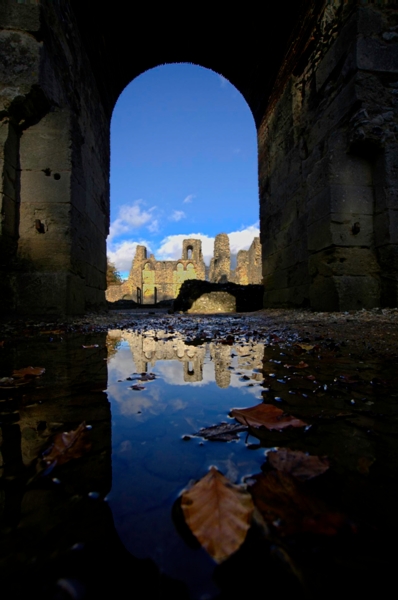
These are the remains of the main residence of the Bishops of Winchester in medieval times.
The palace was started in 1110 by Bishop William Giffard, but most of the surviving ruins were the work of his successor, Bishop Henry de Blois (1129–71). Henry was not only Bishop of Winchester, but a prince, being the grandson of William I and the brother of King Stephen. The palace was a luxurious one, demonstrating the huge wealth and power of the bishop.
The palace was not only the home of the bishops, but it was the place where royalty was entertained when staying in Winchester. Whether Wykeham welcomed or dreaded these royal visits we don’t know, but they were certainly costly. A feast for Richard II in 1393 had 367 guests, and the wedding feast of Henry IV held here in 1403 cost £522. However, given Wykeham’s motto, Manners Maketh Man, I am sure no expense was spared for these royal visitors.
End of walk
There are lots of books and resources about William of Wykeham; a good place to start if you want to know more about him is the Hampshire History website: https://www.hampshire-history.com/william-of-wykeham/

