This walk through the gardens and open places of Winchester is a reminder of how many places have hidden histories waiting to be discovered.
Practical matters
Our walk starts at the King Alfred Statue on the Broadway (SO23 9BE) and ends in Peninsula Square, Peninsula Barracks, Romsey Rd, Winchester SO23 8TS. The first stop is Joyce Gardens, which appears not to have a postcode. However, the house opposite one of the entrances to the park is St Johns Croft, Blue Ball Hill, Winchester SO23 0AF.
The walk is just over 1.4 miles.
The ways up to both Joyce Gardens and Peninsula Square involve quite steep climbs, so these stops can be missed if you prefer a flat walk.
If you are starting by the King Alfred Statue (SO23 9BE), walk behind King Alfred’s back, across the roundabout and continue on the left-hand pavement past the Bishop On The Bridge if you can resist a pint. The pavement on the left opens out onto a seating area and the entrance to St John’s Street.
Turn left onto St John Street, from here you can see the St John the Baptist Church up the hill on your left-hand side. You may want to pause and take a look. It is Winchester’s oldest parish church and is still in continuous use. It is a Grade 1 listed building, with parts of it dating to the early 13th century. From the church continue along St John Street and turn right into Blue Ball Hill. The entrance to the park is on your right, almost opposite the building called St Johns Croft. It can be hard to spot, as there are hedges all around.
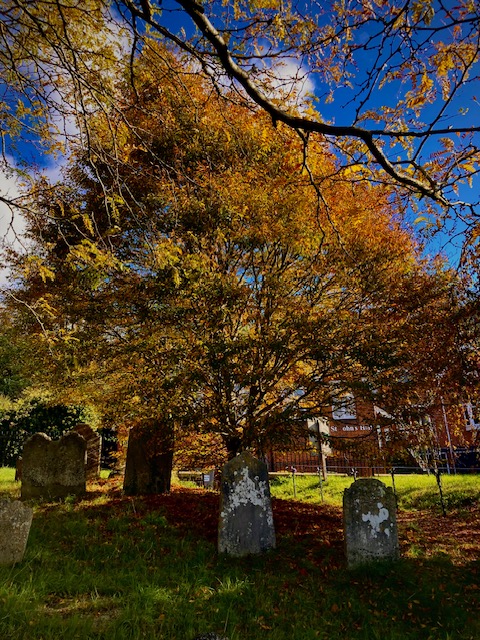
St John the Baptist church © Gavin Mann
Stop 1: Joyce Gardens
Although perhaps not the most beautiful of parks, the views from here are amazing, making it well worth the climb. Taking the path around the garden, looking towards Blue Ball Hill you will see the large half-timbered building you walked past on the way to the garden. This is the Old Blue Boar Inn, today a private residence. It was built in about 1340 and originally called the White Boar Inn. The transformation into the Old Blue Boar reflects shifting times and allegiances.
The White Boar was the emblem of King Richard III, killed at the Battle of Bosworth Field in 1485. The victor of the battle became Henry VII, and it was no longer desirable to be associated with the previous regime, hence the White Boar became the Blue Boar.
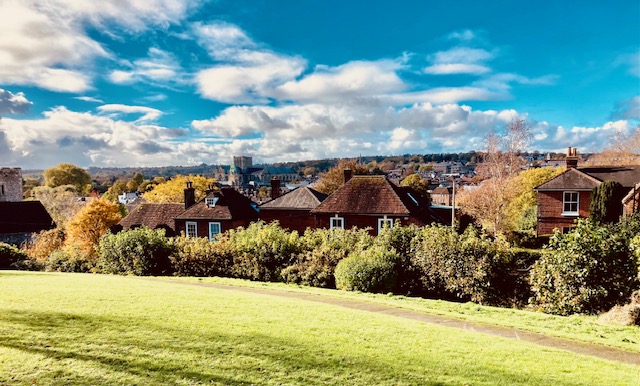
View from Joyce Gardens © Gavin Mann
Walking further along the path, you will see another lovely view. In the foreground is St John the Baptist church, beyond that the Guild Hall, and behind it the east end of Winchester Cathedral. This garden once belonged to St Johns Croft, the Queen Anne town house which you also passed on the way here. It was given to the City Council in 1934 in memory of Ellen Joyce, wife of the vicar of St Johns Church, to recognise her contribution to supporting young women emigrating to Australia, Canada, New Zealand and South Africa. In the late 19th and early 20th centuries in Britain, factors such as war casualties and economic instability had led to an imbalance in the population, resulting in what was said to be a ‘surplus ’of unmarried women. Ellen Joyce was involved with two organisations set up to help deal with the problem: educated, middle-class women of ‘good character’ were encouraged to emigrate to British colonies, where it was believed that they might have better marriage prospects because of another gender imbalance: in these places there tended to be a ‘surplus’ of men. The organisations made an effort to keep in touch with these women for some time after their arrival in the colonies, to provide them with assistance, guidance and support as they adapted to their new lives.
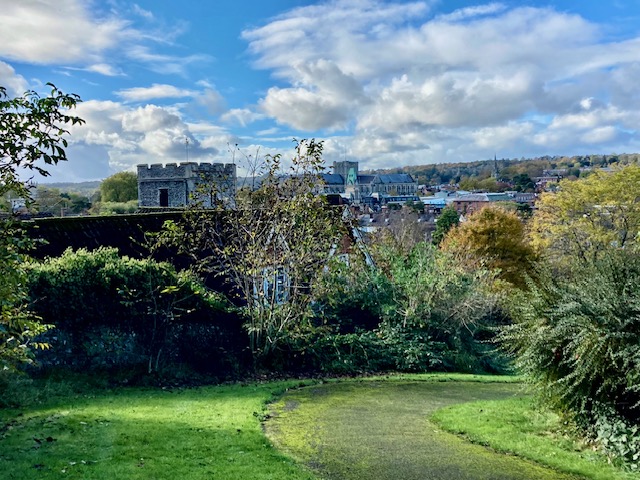
View from Joyce Gardens © Gavin Mann
Leave the garden and retrace your steps along St John Street, walk down the hill towards the roundabout, and use the pedestrian crossing on your left to cross over and continue back over
Bridge St. Take the steps down to ‘the weirs’. This is the path that runs alongside the river Itchen. You will quickly come to some steps on your right-hand side which will take you up into Scott Gardens. Before you go up the steps, you might want to pause and take a look at the visible section of the Roman City Wall, completed in the 3rd Century AD, that once enclosed 144 acres of the city. The wall is behind an iron grill and a helpful map of the Roman City is just above it. These are the only Roman ruins above ground in this city, which they called Venta Belgarum.
Stop 2 Scott Gardens
Despite not being the most visually stunning garden, it offers an elevated spot from which to admire the river Itchen which played a vital role in the development and history of Winchester.
The river flows for 26 miles from New Alresford to Southampton and was an essential geographic feature that influenced the Romans’ choice to found a city here. The river crosses what is now the High Street, which was an ancient route through the chalk downs. This made it an ideal location for a settlement as it provided a natural communication hub.
The river Itchen is a braided stream, meaning it doesn’t have a single, defined channel but consists of many little brooks and streams. The Romans cleverly redirected these smaller watercourses into a single channel, which has been largely preserved to this day. By channeling the river into a single course, the Romans created a natural fortification on one side of their settlement.
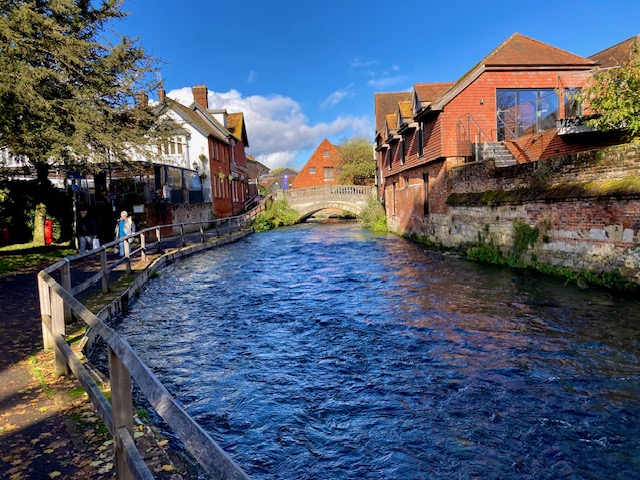
The Itchen, with a view of the City Mill and weirs © Gavin Mann
Weirs were constructed to increase water flow, and this energy was used to power a watermill. The current City Mill in Winchester, just over the bridge to your left, was built in 1744, but there has been a mill here since Saxon times. Historical records dating back to 932 AD mention a watermill owned by a Benedictine nunnery. The foundations of the building suggest that the Saxon mill likely occupied the site of an earlier Roman mill.
This garden is dedicated to Leslie Scott who died in 1952, who had no direct connection to Winchester but is remembered by his sister through this memorial garden, reflecting the ways in which personal connections and memories can create meaningful spaces in a community.
Leave Scott Gardens by the gate opposite the steps from which you came up and turn left into Colebrook Street. Follow the pavement which turns sharply to the right. You will pass the Friends Quaker House on your left, and then Abbey Gardens on your right. Once you pass Colebrook House at 24 Colebrook Street, and are opposite a car park, turn left into the little alleyway, stop in front of the white wrought iron railings, and admire the lovely water garden.
Stop 3: Water Garden
When we think about James Bond, we don’t usually picture a gardener, but the man who created this garden is said to be the real-life inspiration for Ian Fleming’s famous character. He was Sir Peter Smithers, who died in 2006 aged 92. He had a fascinating and varied career, a botanist, a diplomate (perhaps a spy), and finally Member of Parliament for Winchester. His wife had a golden typewriter, which made a cameo appearance in the Bond film, Goldfinger. Peter Smithers lived in Colebrook House, which is on the other side of the brick wall behind you. He had the idea to create a garden for local people, marking this spot which is the gateway from the secular City to the inner close of Winchester Cathedral.
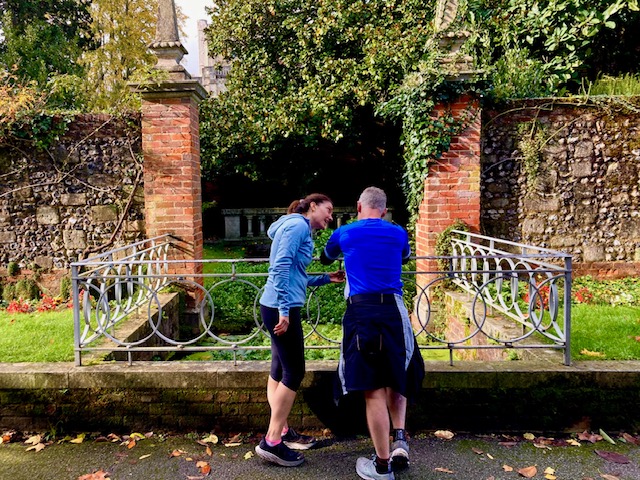
The Water Garden © Gavin Mann
There were four small houses here and the stream you can see now passed under them. They were condemned by the city council in the 1950s as unfit for human habitation. Peter Smithers bought the site and demolished the houses to create this garden. He was helped by the then Cathedral Architect Wilfred Carpenter Turner. They sourced the architectural details, the finals, the balustrade and the statue from reclamation yards and Wilfred Carpenter Turner made the railings.
Sir Peter Smithers, wrote a famous book in the 1950s called The Adventures of a Gardener and in it, he says that gardeners should have confidence in what they plant. He must have been a confident gardener, who else could have predicted the beautiful Magnolia Tree in front of you, would grow so spectacularly? It is a native of South Carolina in the USA, where the climate is very different. Looking towards Colebrook Street you will see a Cypress tree, a common sight in Northern Italy. Peter Smithers had a whimsical idea of a medieval monk that would once have lived in the monastery in the Cathedral Close, make the journey to the Vatican in Italy, and on his journey home, pick up the seed of such a tree and plant it here.
We will follow in the footsteps of the monk and go through the archway at the end of this alleyway, into the Inner Cathedral Close.
Follow the path along, taking in the sight of the east end of the Cathedral, follow the path through the tunnel, and when you leave it turn to your left. Walk past the four columns and through the open round-arched wooden door and up the steps.
Stop 4: Dean Garnier Garden
This garden is on the site of what was once the dormitory (or ‘dorter’ as it was called) of the monks who lived here until the 1530s, when Henry VIII ordered all the monasteries in England to be closed down. Today, it is a beautiful and tranquil place, providing a view of the South Transept of the Cathedral. There are a number of boards with architectural illustrations of the Cathedral, providing interesting information about the view.
The garden was created in 1995 and features traditional elements like yew and box hedges, recalling the historical association of such plants with places of worship. There are three distinct ‘rooms’ or sections, each with its own features and design, which reflect the interior of the Cathedral. The Dorter Garden is the first room you enter and features a Medlar tree set on a lawn. A three-arched metal arbour separates this room from the next; roses called ‘Celine Forestier’ climb the arbour, and stone benches are placed underneath it. The next section, the Presbytery Lawn, incorporates the old Deanery bakehouse. There is a stone bench, and a small stone fox or dog is curled up asleep beneath it. The Latin inscription along the edge of the bench, Non nobis tantum nati, means ‘We are not born for ourselves alone’.
Finally, in a bay set into the yew, which borders the Lady Chapel Garden you will find the spiralling Fish Sculpture. Created in stainless steel and Kirkstone green slate, it was designed and installed by Charles Normandale and the team from Wheely Down Forge Ltd. The sculpture was inspired by the discovery of a water source in the garden and fish as an ancient symbol for Christianity and baptism, when Jesus asked the fishermen Simon and Andrew to ‘follow me and I will make you fishers of men’.
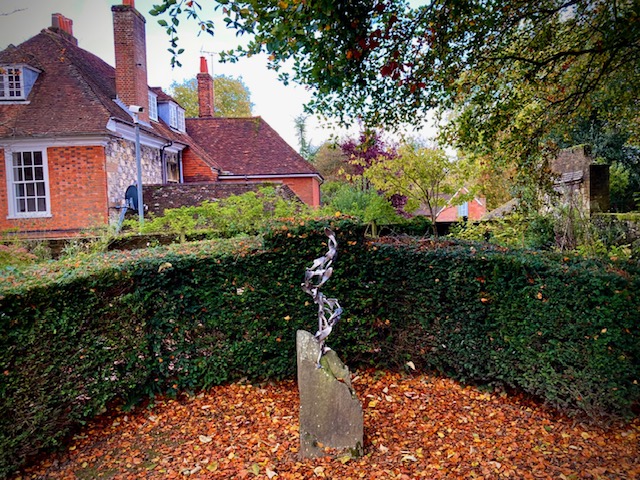
Fish Sculpture © Gavin Mann
The garden is named after Dean Thomas Garnier, who was a notable figure in Winchester during the 19th century. He served as the Dean of Winchester for an impressive 40-year period and was not only a respected clergyman but also a distinguished botanist. He was a founding member of the Hampshire Horticultural Society, and planted many of the trees in the area.
Retrace your steps down from the garden. Turn to your right and follow the pavement, walking under the stone buttresses, until you emerge at the west front of the Cathedral in the Outer Close. This is a lovely spot to stop and have a rest, and you will often find a coffee van here if you need refreshment before continuing with the walk.
Walk up the steps of the Winchester War Monument in front of the Cathedral and take the path leading to the gap in the railings. Leave the Cathedral and walk straight ahead, crossing the road that passes from right to left in front of you and continuing ahead into Minster Lane.
Immediately in front of you and slightly to your right is a garden not open to the public, but it is worth pausing to look through the railings.
This was once the site of the church of St Petroc, which fell into decay in the 14th century following the Black Death; it was rebuilt in 1428 and re-dedicated to St Thomas the Martyr. This second church was demolished in 1845. All that can be seen now in this pretty garden are the tombstones from when it was a graveyard.
Turn to your left and walk past Masons yard then turn right up St Thomas’ Passage, past a telephone kiosk designed by Sir Gilbert Scott and given listed building status in 1987. This will take you to Southgate Street. The garden we are heading for is directly opposite on the other side of the street. However, Southgate Street is a busy road and there is no crossing here, so you will find it safer to turn to your right and cross at the traffic-controlled crossing, then walk back to the garden on the other side.
When you reach the black wrought-iron gates with a gold handle and Tudor Rose, don’t be deterred if they are closed. They are not usually locked, so you can walk inside to look at this memorial garden.
Stop 5: Serle’s House (home to the Royal Hampshire Regiment and memorial garden)
This historical garden is located with Serle’s House as its backdrop. Until 1958, the house was the headquarters of the regiment; it is now a museum. In 1781, the house was sold to James Serle, an attorney, and his son Peter Serle maintained a strong connection between the house and the military which continued for over two centuries.
The garden, designed by Colonel Peter Sawyer, was opened in 1952 to mark the 250th anniversary of the founding of what was then the Hampshire Regiment in 1702 (it was given the title ‘Royal’ following distinguished service in the World War II). It is dedicated to the memory of members of the regiment who died while serving their country. Anyone who has served in the Royal Hampshire Regiment is entitled to have their ashes scattered on the rose beds in the garden.
The garden was designed to be an accessible and tranquil place for everyone. To achieve this, the high brick wall facing Southgate Street was replaced with railings, making the garden more welcoming to visitors.
The carved Bengal tiger faces in the portico above the door and the tiger-shaped door handles are references to the time when the regiment served in India and earned the nickname ‘Hampshire Tigers’.
The garden also features a flagpole on a plinth of Portland Stone, which is inscribed with the names of the countries where the regiment has served over the centuries. The monument displays lines from Shakespeare’s play Henry V, emphasising the contrast between the qualities of modesty and humility in times of peace and the fierce action of a tiger in times of war.
The rose bushes themselves commemorate the Battle of Minden of 1 August 1759, a significant victory for the British during the Seven Years War. Tradition has it that soldiers from the regiment picked roses and placed them in their hats before going into battle. The Minden Roses became an emblem of the regiment and the tradition survives to this day, with members of the regiment annually marking the event by wearing roses in their caps.
Leave the garden by taking the gravel path to the left of the house and follow it along the side of the house. Walk up the seven steps and through the gate. To your left, you will see the St Thomas Church. (this replaced the church demolished in St Thomas Street, where you saw the garden with gravestones). You have a choice here about how to continue. Either go up the steps straight in front of you or, for a more accessible route, take the path to your left and follow it around. If you take the steps, at the top of this first set of steps continue forwards and up the second set. Follow the path up to your right signposted to Peninsula Square. Whichever route you take, when you reach the signpost: keep going and turn left, taking the steep path upwards to Peninsula Square.
Stop 6 Peninsula Square
The beautiful area, which has been greatly transformed over the centuries, was originally built on the orders of King William I in 1067. The castle complex was initially a military site, and it must have been imposing to the newly conquered Anglo-Saxon people. After the royal palace in Winchester burned down in 1141, the castle became a royal residence that was used until the 1500s.
During the Civil War in the 1640s, Winchester was a royalist stronghold. The city was besieged by the parliamentary army led by Oliver Cromwell, resulting in the surrender of the royalists holed up inside Winchester Castle. Following the execution of Charles I, Cromwell ordered the castle to be demolished. After Charles II was restored to the throne in 1660, he expressed interest in Winchester and desired to build a palace. For a small sum he purchased the land where the castle had stood, and commissioned the architect Sir Christopher Wren to build the King’s House. However, the project was left incomplete after Charles II died in 1685.
Over the years, the King’s House had various uses, housing prisoners from different conflicts and providing refuge for French clergy during the revolution in France. In 1796, the War Office assumed responsibility for the buildings, using them as military barracks. The original King’s House was destroyed by a fire in 1899. The current buildings on the site are replacements designed in the English Baroque Revival style, reminiscent of Wren’s architecture. During World War II, the Peninsula Barracks housed troops before they embarked for the Continent, including American forces preparing for the Normandy Landings. Distinguished figures such as Churchill, Eisenhower, Mountbatten and Montgomery inspected troops in these very grounds.

Peninsula Square © Gavin Mann
In 1986, the army moved out, and there were plans to demolish the barracks and build a car park. However, a local architect named Huw Thomas proposed a scheme to reuse the barracks as private homes and open the square as a public garden. Today, the buildings serve as private residences and host five military museums. The name Peninsula Barracks commemorates the soldiers who were once billeted there and fought in the Peninsular War in Spain and Portugal (1807–1814). The garden’s landscaping pays homage to the generations of soldiers who paraded here, and the layout of trees, shrubs and lavender is designed to evoke a military atmosphere. Note how the trees are lined up in pairs, looking as if they are ready to march.
While the homes within the square are private, the square itself is open to the public. It provides a serene and beautiful place to rest, enjoy the fragrant lavender and listen to the soothing sound of fountains.
To leave Peninsula Square, from your entrance point to the Square walk ahead at about a 2 o’clock angle to the gap between the regimental museums on your right and the residential block. Walk towards the gateway with the guardhouse on the left, passing the Rifles / Royal Green jackets museum (with its Waterloo diorama! if you can!). Out the gate and turn right down the hill back to the town centre.
 Winchester Walks