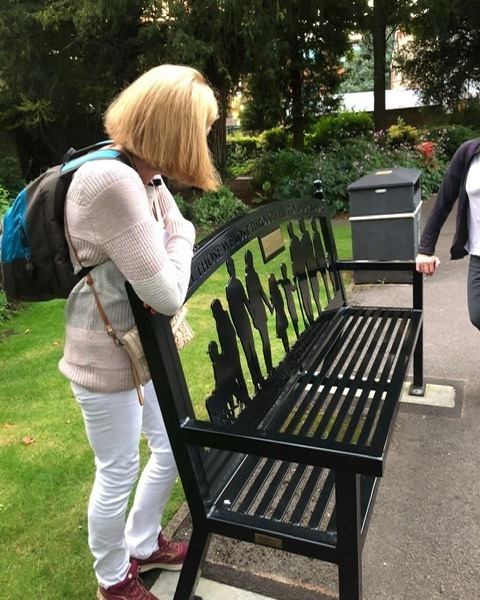
The walk revolves around the theme of remembrance and features four distinct memorial benches, each with its unique significance and link with the past. It covers a diverse route including a hill climb, a stroll along a river and a walk through Winchester’s bustling High Street before finally reaching the historic Great Hall.
These memorial benches serve as poignant tributes to individuals with connections to Winchester. They are part of the city’s legacy.
Practical Matters
The 2.5-mile walk begins with an ascent up St Giles Hill, offering a short yet very steep climb. Particularly on warmer days, it’s advisable to carry some water, to stay hydrated along the way. Please also be aware that the route involves a descent of 152 steps. If this presents too much of a challenge or means the walk is not accessible to you, there is an alternative route indicated below.
Our walk starts at the King Alfred Statue on Broadway (SO23 9BE) and ends at the Great Hall (SO23 8UJ).
From the roundabout behind the King Alfred Statue, take the second exit and cross the bridge, then take the first turning to the left into Water Lane. Follow the river and take the first turn on the right into Blue Ball Hill.
This is where the steep climb of about half a mile begins!
Continue along Blue Ball Hill passing Beggars Lane on your left. Cross Alresford Rd, continue upwards to your left and take the second turning on the right, where there is a street sign saying St Giles Hill. Follow this lane upwards till it opens out. Take the path on the right. Follow down till you reach the four steps down. Take the path on the left that follows the railings until you reach the viewing point.
St Giles Viewing Point
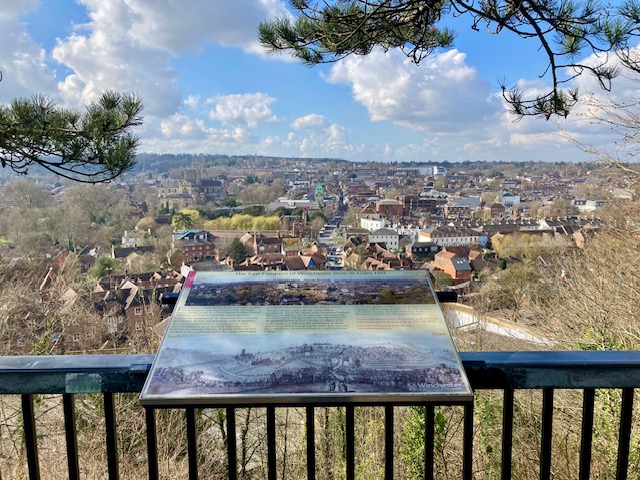
The St Giles Viewing Point offers a spectacular panoramic view of Winchester. From this vantage point, you can see Winchester Cathedral, Winchester College and the remnants of Wolvesey Castle. The High Street lies ahead, marking the route you’ll take later in the walk. Information boards provide historical context, illustrating how the city looked in the past.
The hill gets its name from St Giles, a saint often depicted with a hind (female deer). From 1069, the hill hosted an annual fair commencing on September 1st, the feast day of St Giles. This fair, reaching its peak as a two-week event, was a significant trading occasion. Merchants from across England and even the continent converged on Winchester to showcase and sell their goods. Although the fair’s prominence dwindled from the 13th century, the hill retained its association with St Giles.
Directly behind the viewpoint and up the grassy bank to the middle high path you will find the wrought iron bench.
Paula Moran Seat
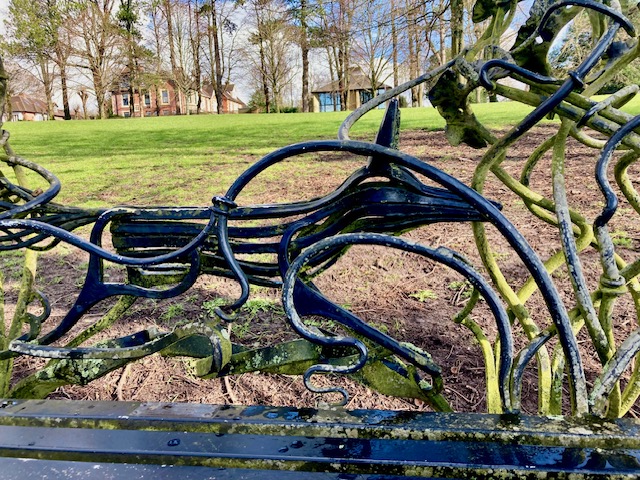
This seat is the first bench on our walk. Dedicated to Paula Moran, who passed away in 1994, the seat is a work of art crafted by blacksmith Richard Bent. Made from hot forged steel, the backrest features a beautifully woven running fox.
I have not been able to find any information about Paula Moran, which perhaps shows that loved ones can be remembered while keeping their privacy.
This bench offers a serene spot from which to appreciate the breathtaking vista. Along the path, you’ll encounter numerous other memorial benches, each commemorating individuals who once cherished this scenic view.
With your back to the bench, turn left on this path carry on till you reach the T junction, turn left upwards and follow to the top of the steps that descend on your right. This is a flight of 152 steps. Take care when descending, as the steps are broken in places.
If you take the steps, you will emerge into Quarry Road. The pavement is narrow, so take care. Continue downwards on Quarry Road till you reach the main road( Quarry Road becomes East Hill at the bottom!) When you reach the main road, Chesil Street, there is a pedestrian crossing, where you can cross the road safely. Double back until you reach the Black Hole B&B and turn right into Wharf Hill. Continue down Warf Hill and take the first sharp right and follow left around the block of flats.
Cross the bridge, and on your left, you’ll notice a sign on the brick wall mentioning the presence of a mill on this site since the 12th century. At this historic sign follow the path behind you and head upriver.
Alternative route: If you prefer not to tackle the 152 steps, you can go back the way you came, and pick up the walk again in Abbey Park (SO23 9BE), which is just opposite the King Alfred Statue.
“Let it be”
There are many memorial benches along The Weirs, but you may want to stop at the one dedicated to John Morgan (1945–2022), who was presumably a Beatles fan. It is located opposite the Chesil Theatre, which is housed in the former St Peter’s Church, dating back to the 12th century. The bench offers a lovely view of the river and the medieval building. The inscription on the bench pays tribute to John Morgan as a much-loved husband and dad, and features the famous Beatles lyrics: ‘There will be an answer, let it be.’ This quote is from the song ‘Let It Be’, and it reflects a message of acceptance and finding peace in difficult situations.

Continuing along the river, you will emerge onto Bridge Street. Turn left and walk along the street until you reach the gateway into Abbey Gardens. Turn left into the gardens and follow the path in a clockwise direction.
Abbey Gardens
The name of this pretty park recalls the nunnery founded on this site by Ealswitha, the wife of Alfred the Great, in around 903. The nunnery, known as Nunnaminser, was here until the dissolution of the monasteries in 1539. The fine house to your right as you enter the park was built in 1699 by the wealthy Pescod family. Today, it is the official residence of the Mayor of Winchester.
You will notice that many of the benches along the path around the garden are memorials. Just over halfway round, to the right of Inn The Park cafe, one bench stands out from the rest.
Memorial Bench given by Winchester Bereavement Support
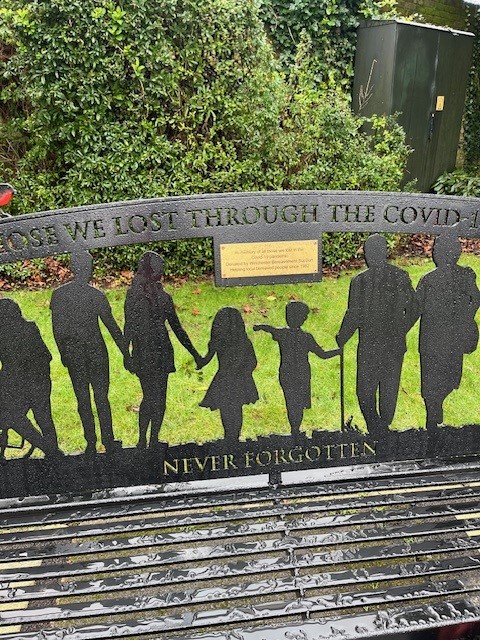
The inscription on this bench is a tribute to those who lost their lives during the COVID-19 pandemic. The symbolic image on the backrest of people of various ages joining hands emphasizes the collective experience of grief and loss.
The presence of a robin perched on top adds another layer of symbolism, as this bird is often associated with departed loved ones and new beginnings. Its inclusion in the design serves as a reminder that, even in times of sorrow, there is hope for renewal and fresh starts.
Roll and Scroll, a metal fabricators company in Grantham, created this bench. The company specializes in memorial benches and made one for Captain Tom Moore, who raised money for charity in the run-up to his 100th birthday during the pandemic. It was that event that started all the Covid memorial benches they have made.
The bench was funded by Winchester Bereavement Support, which provides free assistance to bereaved adults in the area. It underscores the importance of community support during times of grief.
The unveiling of the bench in October 2023 not only marks a physical addition to the community but also provides a meaningful space for reflection and remembrance. Leonie Mountney, the Chair of Winchester Bereavement Support, has expressed the organization’s satisfaction at being able to contribute this bench to the people of Winchester, allowing individuals to rest and contemplate, ensuring that the memories of their loved ones are never forgotten.
When you leave the gardens there is a half-mile walk up the High Street. This is an opportunity to grab an ice cream or coffee from one of the many stalls and cafes along the way. Continue towards the Westgate, one of the ancient, fortified gateways in Winchester. At the Westgate go round to the left-hand side and follow signs to the Great Hall and Round Table. Follow the path around in a clockwise direction until you are outside The Great Hall. From here, looking to your left, you can see St Giles Hill in the distance. To your right is ‘A Promise Honoured’.
A Promise Honoured
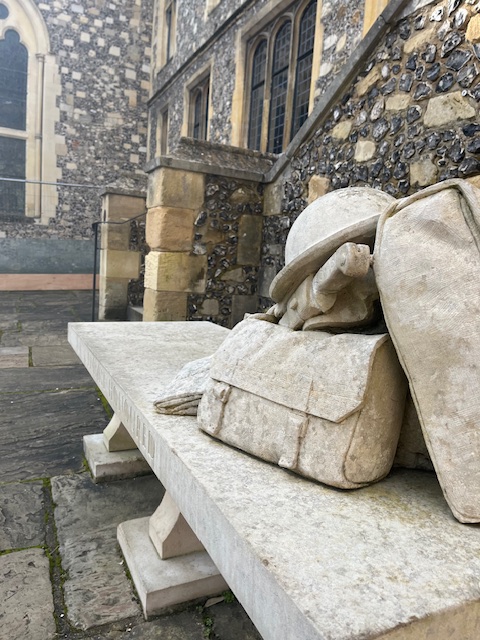
This is a stone bench with a pile of a soldier’s kit and helmet at one end. The bench, created by the master stone carver Simon Smith, is made of Portland stone and serves as a memorial to the thousands of troops who passed through Winchester during the First World War. It honours a promise made by the Mayor of Winchester in 1919 to commemorate the American soldiers who were stationed on the hills around the city. The bench depicts a soldier’s kit left on a railway bench.
World War One was the first modern war, in which mechanized warfare and new technology were used to destructive ends. It was characterized by trench warfare, where many men and boys lost their lives. On their way to the battlefield, soldiers were accommodated at Morn Hill Camp near Winchester, often in terrible conditions. The camp opened in 1914 and, by December of that year, 5000 troops were there, living under canvas in the snow. By the end of the war, the camp had been home to over 2 million men, including 750,000 troops from the United States of America.
Finally, in 2014, the promise made almost a hundred years earlier was fulfilled, and the memorial was unveiled by HRH the Duke of Gloucester on June 23. Although the bench is a sculpture, visitors are welcome to sit on it, reflect and enjoy the view.
 Winchester Walks