If you are interested in the history of Winchester and would like to take a walk, this is perfect for a rainy day. There are lots of inside stops free of charge.
Practical matters
- We start the walk in W.H. Smith, 110 High Street, Winchester SO23 9AH. If you prefer to do it in reverse, start at Kingsgate, Kingsgate St, Winchester SO23 9PD. The route, either way, is about half a mile long with 7 stops.
- All the stops on this walk are inside (or at least under cover), so ideal for wet weather but not ideal for dogs.
- All the stops are free to enter. We go inside one bakery and one hotel where you may want to get a cake or a drink, but there is no obligation.
If you are doing this walk on a Sunday, please check the opening hours of the shops and service times in the churches.
Stop 1: W.H. Smith
If it is not raining too hard, take a look at the building before you go inside. It is a Grade II-listed structure, built in 1867 as a Masonic Hall. The carved stone Masonic symbols can still the rear of the building on the Parchment St corner where it meets St George St. It was converted into a shop for W.H. Smith in 1927 by architect J.W. Williamson, of Blount and Williamson of Salisbury.
Enter the shop and take the stairs to the first floor. There you will find the most surprising murals, depicting ancient kings associated with Winchester. At one end is the legendary Arthur and his Round Table, and at the other end is Alfred the Great in a shepherd’s hut.
No one is quite sure if King Arthur really existed or if he is a character from medieval fiction. If he did exist he would have been a leader in the late 5th to early 6th centuries. Whether true or not, people in the 12th and 13th centuries loved the stories about King Arthur, noble knights and Queen Guinevere. Camelot is a fictional castle associated with Arthur and, in some sources, it is said to have been in Winchester. The Great Hall in Winchester houses the Round Table, but sad to say, the experts have dated it to the 13th century – long after Arthur’s time.
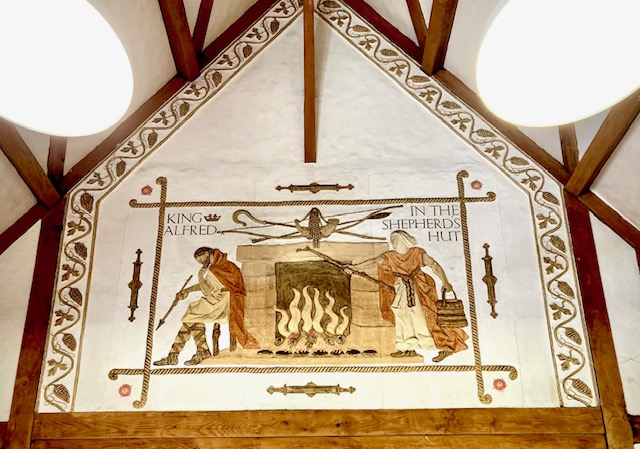
In contrast, Alfred the Great was definitely a real person: King of the West Saxons from 871 to 886, and King of the Anglo-Saxons from 886 until his death in 899. There is an unmissable statue of him on the High Street in Winchester. Alfred spent many years of his reign fighting a Viking invasion. He finally won a decisive victory in the Battle of Edington – about 40 miles west of Winchester – in 878. The mural in W.H. Smith depicts an earlier episode when his struggle against the Vikings was going very badly. He was forced to flee to the Somerset Levels, where, according to legend, he was given shelter by a peasant woman. Unaware of who he was, she left him to watch some cakes she had left cooking on the fire. Worried about the problems of his kingdom and the Vikings, Alfred accidentally let the cakes burn; he was scolded by the woman upon her return, and he apologised. There is no contemporary evidence for the legend, but if it is not true, it perhaps shows that people recognised Alfred as a humble man.
On the side walls between the trusses are murals depicting:
William of Wykeham, the Bishop of Winchester from 1367 to 1404. He is shown building Winchester College which still exists today as a private school in College Street.
Sir Walter Raleigh, who was tried for treason in the Great Hall in Winchester in 1603.
Mary I and Philip of Spain, who married in Winchester Cathedral on 25 July 1554
There are also reindeer, oak trees, archers, a knight and two saints.
Leaving the shop, turn right up the High Street until you reach the Butter Cross Monument. Behind the monument is the Winchester Bakery – go inside and take the stairs up to the eating area. On reaching the first floor you will see a fireplace with an arch beside it. Go through the arch: the fireplace you are interested in is on the other side of the one you saw when you walked into this eating area.
Stop 2: The Winchester Bakery
The Winchester Bakery’s painted and decorated fireplace has recently been restored. The timber-framed building is thought to have been built in the 1500s and is Grade II listed.
You will see that, above the fireplace, there are two decorative schemes. The first, to the left-hand side, includes the Arms of the City of Winchester. You can see the five gates of Winchester and two lions. In the centre, there is what is thought might be the Royal Coat of Arms of Elizabeth I, which would have been painted in the mid to late 1500s.
The second scheme is an elaborate with a design which the experts date to between 1620 and 1640.
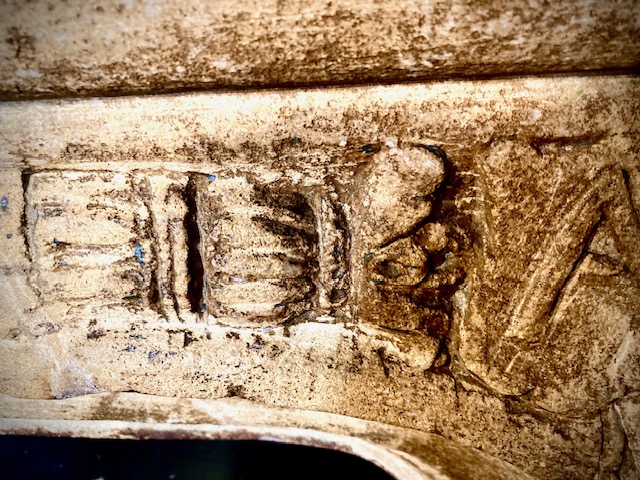
Most interesting, I think, are the initials carved into either side of the fireplace. At first glance, the initials appear to be P A, but the experts think that the P is in fact a damaged R. In that case, they probably refer to Richard Adderley, a haberdasher – someone who sold small articles for sewing and knitting – who in 1572 was granted a 40-year lease for this building.
Go down the stairs and take the exit into the alleyway. Directly opposite is the church of Saint Lawrence. Look carefully, as the church is tiny and it is easy to miss the door.
Stop 3 Church of Saint Lawrence
There was a church on this site before the Norman conquest of 1066 and it was incorporated into a palace built by William I as a royal chapel. It was destroyed by the fire of 1141, rebuilt in 1150 and has been restored several times since then.
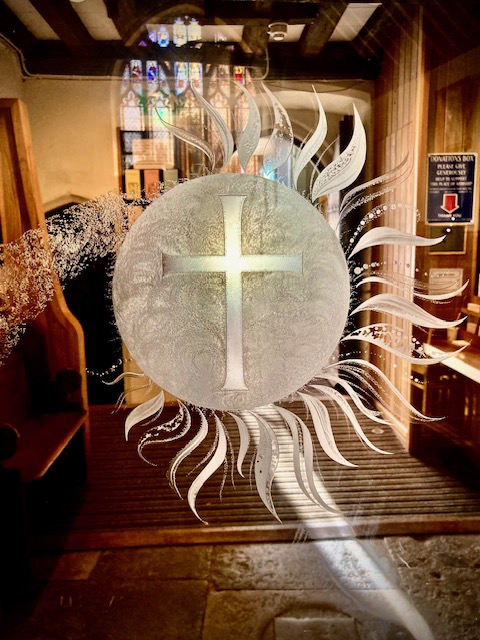
Before entering the church, look at the beautiful glass screen engraved by local artist Tracey Sheppard in 2012. She said of this work, “The engraving comprises a wealth of Christian symbols” combined with local touches “such as butterflies from the meadow”. Sheppard used many techniques to achieve the final result, including dentist drills and acid. The words engraved on the glass come from a poem by George Herbert (1593 –1633) called “The Elixir”. You can read the whole poem here https://www.poetryfoundation.org/poems/44362/the-elixir .
Inside you will see a memorial to Dr. Lyford who treated Jane Austen, the famous English novelist, during her final illness in Winchester in 1817. Jane is buried in Winchester Cathedral.
This church is associated with a special tradition when a new Bishop of Winchester is on his way to be enthroned in the Cathedral. He first comes to Saint Lawrence to pray and put on his robes. He then tolls one of the church bells, ringing himself into office. The new Bishop then leaves to meet the Mayor, the Cathedral clergy and the citizens of Winchester and proceeds from Saint Lawrence to the Cathedral.
Leaving the church, turn left and, on the other side of the road, a few metres along, you will come to a shop called Hambledon.
Stop 4: Hambledon at 10 The Square
Enter this shop and go down the stairs to the basement. You will then be standing in what was once a royal palace. Many of the shops around here boast Norman cellars or walls because, when William I conquered England in the 11th century, he ordered three great building projects in Winchester. The first, and still standing, was the Cathedral. The second was a great castle complex of which today only a few ruins remain above ground. The third project was here, a new royal residence on the site of an old Saxon palace. Sadly, William’s new palace did not last long – it was burned down in 1141 during the civil war between two of his grandchildren, Stephen and Matilda, and was never replaced. Although this shop was built in the late 18th or early 19th century, it is likely to have been constructed over the sturdy Norman cellars that remained below ground.
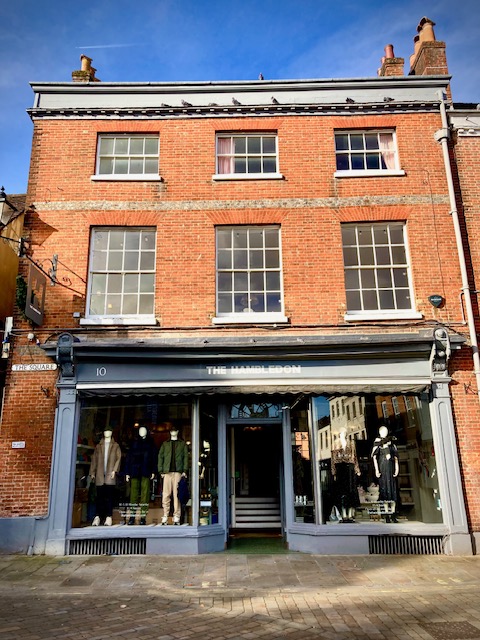
The shop’s website proudly describes the building’s history: it says, “The Norman basement (once a warren of spooky stockrooms) is now a happy home for a fully-fledged menswear offer.”
On leaving the shop, go straight ahead down The Square following the road round to the left then take Market Lane on your right. Approaching the Mercure ignore the rear entrance and continue down the street side of the building and follow it round to the right where you will find the main entrance to the Mercure Wessex Hotel. Through the entrance, you will find the hotel reception on your right and the Kings Lounge on your left. The map you will want to look at. is situated on the wall on the left behind the spiral staircase in the Kings Lounge.
Stop 5Mercure Winchester Wessex Hotel, Paternoster Row
This hotel is directly opposite the north side of the Cathedral, and the architecture is perhaps something of a surprise in a city that boasts of its ancient buildings. It was built between 1961 and 1963 by the architectural firm Feilden and Mawson. Sir Nikolaus Pevsner, the great architectural historian best known for his series of county-by-county guides, The Buildings of England, considered this building a triumph of Modernism. He said, “It uses the c20 idiom without compromise and proves it can stand up to the idioms of the past and even a cathedral.”
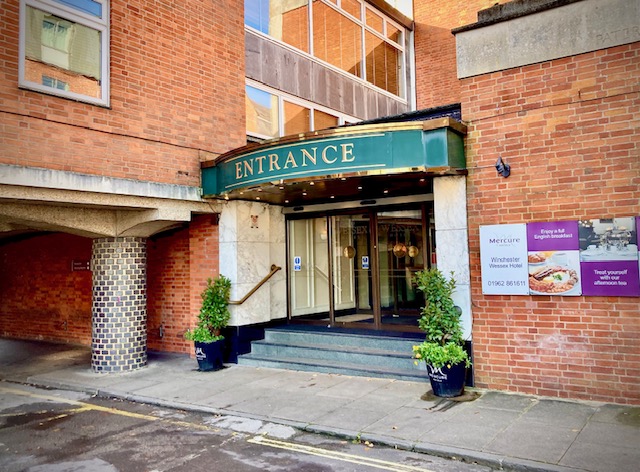
There were objections when the building was at the planning stage and to surmount them Feilden had a group of supporters secure a special Act of Parliament to allow its construction. It was not universally unpopular – an article published in the Hampshire Chronicle quotes an elderly resident remembering: “When the Wessex Hotel (now ‘Mercure’) opened, it was considered daringly modern. The wealthy drove from miles around to dine amid its luxury and to feast on its cathedral outlook.”
By the reception desk are twelve back-lit stained-glass panels arranged in a grid. These are by the artist John Egerton Christmas Piper(1903–92). They feature a Green Man motif, apparently a recurring theme of the artist’s work. I think they were also inspired by this hotel’s location opposite the Cathedral, which, in the choir stalls, has a magnificent Green Man carved in the early 1300s.
To find the map I would like to share with you, turn left before the reception desk into the bar area.
The title of the map is “To the worshipful the mayor, corporation and representatives in Parliament of the city of Winchester, this map of that city is humbly dedicated by their most obed.t serv.t Will: Godson” William Godson was an innovative map maker who created this map in 1750. What you see here is a copy: the original is in the British Library.
The map is fascinating for all sorts of reasons, and it is easy to become immersed in looking for what has changed and what is the same over 270 years. What hasn’t changed is the use of images of King Arthur’s Round Table to promote Winchester. It has pride of place on Godwin’s map and Visit Winchester and other local websites use similar images today to attract tourists.
We don’t know how many people lived in Winchester in the 1700s – these were the days before the census – but it wasn’t heavily populated. You can see that at the time there was little building outside of the 144 acres (about half a square kilometre) encircled by the original city walls. Even within this inner city, there were areas of fields, particularly in the southeast corner.
Some of the buildings featured on the map that you can still visit today are the Bishop’s Palace (Wolvesey Castle), the College of Saint Mary’s Winton (Winchester College), the Market Cross, and the Guild Hall (now Lloyds Bank in the High Street).
The building labelled “The County Hall” on the map, we now call the Great Hall. The caption says that it was built by King Arthur, son of Pendragon. Sadly, this is a romantic fantasy: the Great Hall was built much later, in 1222 by Henry III, a far less romantic monarch.
The Seat of Edward Sheldon Esq. is today known as Serle’s House, and it was built in 1730. It is in Southgate Street and is now home to the Royal Hampshire Regiment Museum. Another building we can still see is the Seat of William Pescod, the Recorder of Winchester. Today this building is known as Abbey House, and it is the official residence of the Mayor of Winchester, set in Abbey Gardens, just opposite the bus station. It looks rather different today, because the front elevation we see on the map is now the back of the house facing the park; what was the back of the house in 1750 was remodelled and now faces the street.
A building no longer with us is the Seat of Henry Penton Esq. In 1761 Henry Penton became the Member of Parliament for Winchester, and his house was known as Eastgate House. Its claim to fame was that in 1778, Penton entertained George III and Queen Charlotte for two nights on their visit to Winchester. Sadly, the house was pulled down in 1846–7, but you can still see the gates to it. These wrought-iron beauties can now be found gracing Kingsland House on Chesil Street, just a short stroll away.
The King’s House no longer exists: it sadly burned down, but you can find out all about it in our blog about gardens and open spaces.
Stop 6: The Slype Tunnel and Winchester Deanery
Leave the Mercure Winchester Wessex Hotel, turn right, and follow the path so that you are walking between both the hotel and the Cathedral.
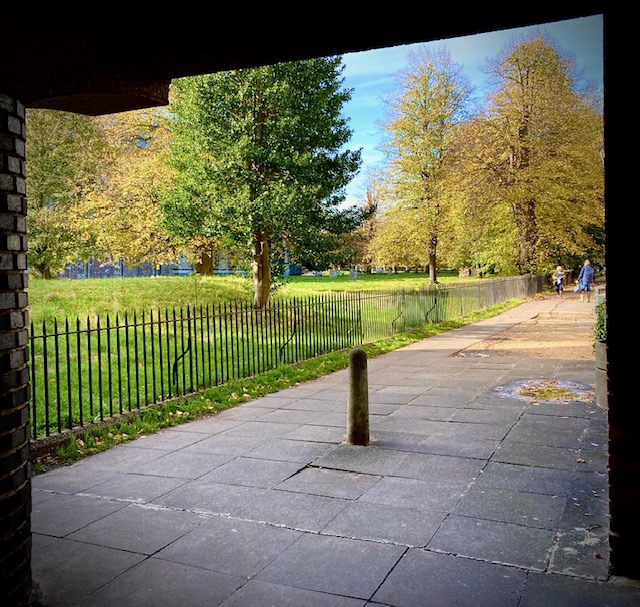
Follow the path as it bears left then turn left again past the front of the Cathedral. Continue past the Cathedral and turn left around the Cathedral walls through the arched gateway. Continue in the same direction under the arches of the Cathedral’s flying buttresses until you reach the end. Turn right, follow the pavement and the tunnel opens on your left.
On a rainy day, the entrance to this tunnel is a good place to shelter. It is known as The Slype. Slype is an uncommon word and means a covered way between a cathedral transept and the Chapter House or Deanery. As you look out from the tunnel back towards the green, what was the Chapter House is immediately to your left. In the days of the Benedictine Priory that once stood on this site, the Chapter House was where the monks would read. At the end of the pavement to your left, the Deanery still stands, but before we go and look at it, it is worth taking a closer look at the tunnel. You can see that the walls are covered in graffiti, much of it very old. For almost 200 hundred years, Winchester was a military city, and I can imagine many soldiers sheltering here from the rain. You can see that some of them came well prepared with chisels to deeply carve their names or initials. Carved near the end of the left wall of the tunnel (as you face the green) is a square with a cross, and next to that a second square with a cross and a circular hole in the centre. It is likely that these soldiers or perhaps choir boys were playing a game. The interior of the cathedral is also covered in graffiti, and the carved game appears inside too. We often think of cathedrals as places where the great and the good are remembered – but very ordinary people have left their mark here.
Exit the tunnel the same way you entered and turn left on the pavement. Leaving the tunnel, continue to follow the pavement as it turns to the left. You can take shelter again under the porch of the Deanery. The Deanery is the last building on your left with five buttresses on your pavement side. Follow the pavement around to the left and then left again where the porch and another green area open up. On the left of the porch, the Deanery bookshop is often set up here.
Much of this house was rebuilt in the 17th century, but the porch you are standing in is one of the earliest surviving examples of a medieval domestic porch and it is dated at around 1250. The floor tiles are lovely, and I have been told they were old Roman tiles, but so far I have found no reference to back this up.
Today the Dean of the Cathedral lives in this house. Before 1539 it was the home of the Prior, the most senior monk of the Benedictine Priory that was here until the Church of England broke away from the authority of the pope and the Catholic Church. At that point, this monastery and indeed all monasteries and nunneries in England were closed down. The last Prior living here was a monk called William Basing. He seems to have wanted to keep his lovely house despite the change in national religion, because only two years later he was living here once again, this time as the first Protestant Dean of Winchester under his family name of William Kingsmill.
On leaving the Deanery porch walk straight ahead and follow the road past the Pilgrims school on your left. Follow the road round to the right through the arched gateway with old wooden gates. (These gates are closed at night every night at 10pm.) Standing by the wooden gates with your back to the Pilgrims School the arches to your left. Just beyond the three arches on your left is the entrance to Saint Swithun upon Kingsgate, with black wrought iron railings in front of a wooden door, and a notice board to the right of the door.
Stop 7: Saint Swithun upon Kingsgate.
The gate arching the street is Kingsgate, built in the 1300s. This is one of the five entry points to the walled city. Only two of the original city gates remain; this one survived because, as we will see, it serves another purpose.
Step through the opening in the wrought iron railings and go through the wooden door (open it if closed). Carry on up the wooden staircase in front of you, and you have arrived inside the church of Saint Swithun upon Kingsgate.
This tiny church is still a working church with regular services. Saint Swithun was the Bishop of Winchester when Alfred the Great (he who burnt the cakes) was a boy. Swithun died in 862 and fairly soon afterward became the patron saint of the Anglo-Saxon church that preceded the Cathedral. Legend has it that when his bones were moved from their burial place outside into that Saxon church, the saint was so cross at the disturbance he caused it to rain. Even today on Saint Swithun’s Day, 15th July, people say:
On Saint Swithun’s Day, if then dost rain,
For forty days it will remain.
Let’s hope the rain stops soon and you can enjoy some of the sunny-day Winchester walks you can find on this blog.
More information
If you would like to know more about the fireplace and paintings in the Winchester Bakery, its website has some interesting information about it and its restoration: https://www.winchesterbakery.co.uk/history/
If you would like to study the Godwin map in more detail, a good image can be found at https://www.flickr.com/photos/britishlibrary/50264758123
Information about the Deanery can be found at https://www.hantsfieldclub.org.uk/publications/hampshirestudies/digital/1980s/vol43/Crook.pdf
 Winchester Walks
Leave a comment